What Is a WIP Schedule? A Guide for Houston Construction Companies
Running a construction business in Houston means managing several active job sites at once. You chase payments, manage crews, and ask one key question: Is each project making money?
For many contractors, the answer remains unclear until the job ends. By then, fixing a costly problem may be too late.
A WIP schedule changes that story. This financial report shows each job’s costs, billings, and profit margins in real time. Instead of guessing, you get clear numbers to guide action today.
This guide explains what this report is and why it matters for Houston builders. It also covers the main parts and common reporting mistakes.
You’ll see how Jones CPA Group helps local contractors. This Houston, Texas firm focuses on construction accounting and bookkeeping, keeping reports accurate and projects profitable from start to finish.
Key Takeaways
- A WIP schedule tracks job costs, billings, and profit in real time, not just at project completion.
- Houston contractors face unique cash flow pressures from managing multiple concurrent projects.
- Accurate job progress reporting helps you catch profit problems before they grow into big losses.
- Common reporting mistakes can hide overbilling or underbilling issues on active jobs.
- Jones CPA Group specializes in construction accounting and bookkeeping for Houston-based contractors.
- This guide covers the core components, best practices, and expert support available for accurate reporting.
What Is a WIP Schedule?
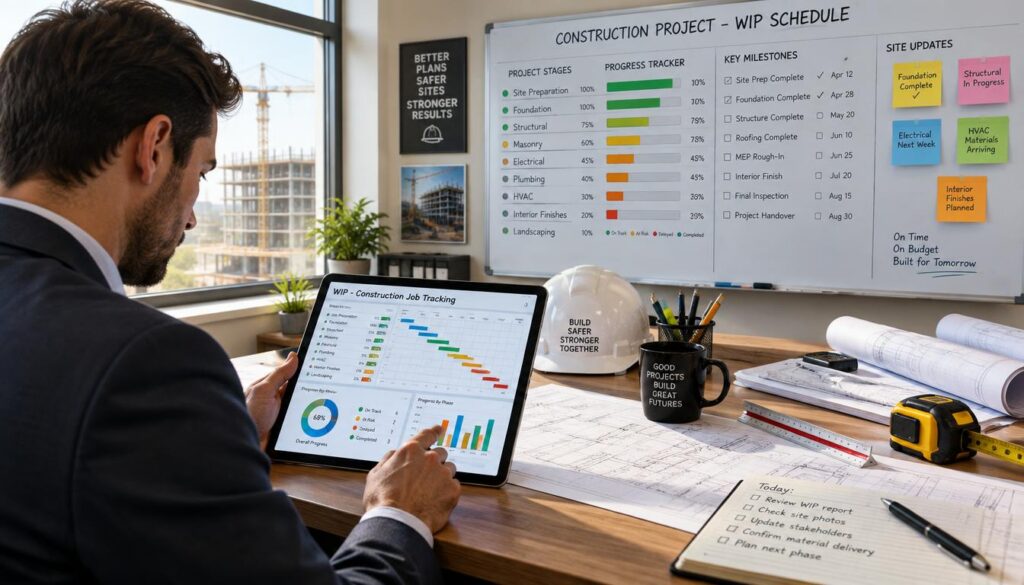
A work in progress schedule is more than a spreadsheet; it keeps contractors from flying blind. It shows whether each active project is profitable before the job ends. The report tracks contract value, costs incurred, billings, recognized revenue, and projected profit for every active job.
For Houston builders managing multiple sites, subcontractors, and change orders, this visibility is essential. It helps them catch problems early instead of finding damage after the job ends.
Breaking Down the Basics of a Work in Progress Schedule
A WIP schedule is a job-by-job report. It lists each active project with four key figures: contract value, spending so far, client billings, and work completed.
Together, these numbers show whether billing matches progress and costs match the original estimate. They also reveal whether a job is quietly draining cash.
This is not a yearly report. Most contractors update their wip schedule monthly, or more often on larger jobs, to support current decisions.
How a WIP Schedule Differs from Standard Financial Statements
Confusion often starts here. A profit and loss statement or balance sheet shows the company’s overall performance. It combines every job, overhead cost, and revenue dollar into one broad summary.
A WIP schedule does the opposite. It focuses on each job, showing which projects lead, lag, or have mismatched billing.
This difference matters more than many contractors realize. A company can show a healthy paper profit while one or two jobs lose cash. Stronger jobs can hide those losses in the company’s combined results.
If you rely only on standard financials, you miss these details. The table below compares these two reporting tools.
| Aspect | WIP Schedule | Standard Financial Statements |
|---|---|---|
| Scope | Individual, job-by-job detail | Company-wide totals |
| Timing | Real-time, updated monthly or per billing cycle | Typically monthly, quarterly, or annually |
| Primary Purpose | Tracks job profitability, billing accuracy, and cash risk | Shows overall business health and tax reporting |
| Reveals Overbilling/Underbilling | Yes, immediately visible per project | No, hidden within combined totals |
Contractors who review both reports side by side see the full story. The WIP schedule finds job problems, while standard financials show their impact on the whole business.
Why Houston Construction Companies Need a WIP Schedule
Every day, Houston contractors manage several active job sites and worry about enough cash for next week’s payroll. The Houston, Texas construction market moves quickly, and profits can disappear when money remains tied up in unfinished work.
A strong WIP schedule gives contractors a clear financial view of every job in progress. It shows where money is committed, owed, or at risk before a problem becomes a crisis.
Managing Cash Flow on Active Projects
Construction cash flow rarely follows a straight line. Retainage clauses usually hold back 5% to 10% of each payment until a project ends, leaving contractors short of funds already earned.
Payment chains create more delay. Money often moves from owner to general contractor, then subcontractor and supplier, under Net-30, Net-60, or even Net-90 terms. This stretches the wait for cash already spent on labor and materials.
Projects also require major upfront spending. Upfront mobilization, equipment rental, and material costs hit before the first invoice, creating a gap between expenses and income.
Contractor WIP reporting helps close that gap by showing how much cash is tied up across active jobs. It includes cash already spent on labor and materials. Instead of reacting to payroll pressure, Houston contractors can spot shortfalls weeks ahead and adjust financing or billing before trouble starts.

Meeting Bank, Bonding, and Surety Requirements
Growth in the Houston construction market often depends on credit and bonding capacity. Banks and surety companies want proof that contractors manage risk before extending credit or backing a bond.
Current, accurate WIP schedules give lenders and sureties data to judge bonding capacity and contractor risk. Without this reporting, even a financially healthy company may struggle to qualify for larger commercial or public projects.
The table below shows what different stakeholders typically expect in a contractor’s WIP reporting.
| Stakeholder | Primary Concern | What They Look For in a WIP Schedule |
|---|---|---|
| Bank | Loan repayment risk | Consistent billing patterns and healthy cash position across projects |
| Surety | Bonding capacity | Accurate cost-to-complete estimates and profit fade trends |
| General Contractor | Subcontractor reliability | Evidence of financial stability on current job commitments |
| Project Owner | Completion risk | Clear percentage-of-completion tracking tied to actual billings |
Consistent, well-prepared contractor WIP reporting often separates Houston contractors who stay small from those who grow into bigger, profitable work. Texas contractors treating WIP schedules as routine financial management find it easier to build trust with banks and sureties.
Key Components of a Construction WIP Schedule
Think of a construction WIP schedule as a puzzle with four essential pieces. Each piece answers a different question about your project. Together, they show how the job is performing.
These four numbers appear on every properly built construction WIP schedule, regardless of company size or project type. Knowing each number makes the report easier to understand.
Contract Value and Estimated Costs
Contract value is the total amount your customer agreed to pay for the job. Estimated costs show what you expect to spend before finishing the work.
Here is what contractors often miss: this figure should use your current estimate. It should not use the original number from your bid.
Change orders happen. Material prices shift. Scope adjustments occur during the project. Your WIP schedule must show reality, not numbers from months ago.
Costs Incurred to Date
This is where solid job cost WIP analysis begins. Costs incurred to date track every dollar spent on one specific job.
This figure typically includes:
- Labor costs for crew members working on the project
- Materials purchased and used on-site
- Subcontractor invoices and payments
- Job-specific overhead, such as equipment rental or permits
Accuracy matters most in this part of the schedule. If these costs are wrong, every related calculation will also be wrong.
Billings to Date
Billings to date means the amount you have invoiced your customer for that job. This number often differs from costs incurred, and the gap tells a story.
When billings exceed costs, you are overbilled. When costs exceed billings, you are underbilled. Both situations affect cash flow and need close attention.
Percentage of Completion Calculation
Now comes the calculation that connects everything. Most Houston contractors use the cost-to-cost method because it is straightforward.
The formula is: costs incurred to date divided by total estimated costs, multiplied by 100, equals your percentage complete.
Here is a real-world example. A contractor spends $300,000 on a project with $1,000,000 in total estimated costs. The project is 30% complete.
At that point, the contractor should generally recognize 30% of total contract revenue, following standard accounting guidance. This percentage provides a benchmark for comparing actual billings.
When you compare contract value, costs incurred, billings, and percentage complete, you see more than four numbers. You see job health and can find problems early.
Understanding Over and Under Billings
A percentage of completion schedule shows project progress, but billing and earned revenue can drift apart. This gap creates overbilling or underbilling, both common in Houston’s construction industry. Neither is automatically bad news, but early action protects your bottom line.
An over and under billings schedule clearly shows where each project stands. Think of it as a health check for job cash, flagging problems before they reach your bank account.
What Overbilling Means for Your Business
Overbilling happens when you bill more than completed work justifies. It can feel like a win because cash arrives early and accounts look strong.
However, that money is not fully earned. It remains a liability, not real profit. If delays, scope changes, or unexpected costs affect the project, you may need to cover the gap or return funds.
Contractors who overbill regularly without close tracking can face a rude awakening. The cash looks available, but it is owed against unfinished work.
What Underbilling Signals About Cash Flow
Underbilling works the opposite way. Your crew completed more work than you invoiced, so you finance the client’s project with your own money.
This situation quietly drains cash reserves. Payroll, materials, and subcontractor payments continue, while the invoice bringing money back lags behind. Over time, this strain may force a contractor to use credit lines to keep operations running.
Regular reviews help you spot these signals before they become a cash crunch. Watch for these warning signs:
- Consistent gaps between costs incurred and amounts billed each month
- Rising reliance on credit lines to cover payroll or supplier invoices
- Project managers reporting work progress that outpaces billing schedules
- Cash reserves shrinking even though jobs appear profitable on paper
Neither overbilling nor underbilling spells disaster by itself. The real danger comes from ignoring either pattern too long, so accurate schedules give Houston contractors needed visibility. An accurate percentage of completion schedule and well-maintained over and under billings schedule help contractors correct course before small imbalances become serious cash flow problems.
WIP Schedule Format and Template Options
Imagine opening a spreadsheet and seeing job numbers beside strange percentages. That is what a WIP schedule looks like at first.
Once you understand the layout, it becomes a valuable accounting tool.
Learning the standard wip schedule format removes the mystery. It turns numbers into a clear story about each job’s health.
Standard WIP Schedule Layout
A typical WIP schedule lists every active job in its own row. Columns run across the top.
Each column shows one part of the financial picture. Together, they show if a project is on track, ahead of billing, or behind.
Here is what you will usually find in a well-built wip schedule template:
- Contract value — the total agreed price for the job
- Total estimated costs — your projected expense to finish the work
- Costs incurred to date — actual spending so far
- Percentage complete — costs incurred divided by estimated total costs
- Revenue earned — contract value multiplied by percentage complete
- Amount billed to date — what you’ve actually invoiced the client
- Over/under billing — the gap between revenue earned and amount billed
Place these figures beside a few sample jobs, and the pattern becomes clear.
| Job Name | Contract Value | % Complete | Billed to Date | Over/(Under) Billing |
|---|---|---|---|---|
| Westside Retail Build | $850,000 | 50% | $475,000 | $50,000 (Over) |
| Heights Apartment Renovation | $1,200,000 | 50% | $540,000 | ($60,000) Under |
| Downtown Office Fit-Out | $430,000 | 50% | $215,000 | $0 (Even) |
Three jobs can be 50% complete yet have very different billing positions.
That is the value of project work in progress tracking. It flags trouble before trouble reaches your bank balance.
Choosing the Right Software or Template
Not every contractor needs the same tool for building this report.
A simple wip schedule template in Excel or Google Sheets works for two or three jobs. Update figures by hand once a month.
It costs nothing extra, stays flexible, and adjusts easily as your reporting needs grow.
Once you manage a dozen or more active contracts, manual spreadsheets create more work than they save.
That is usually when Houston contractors choose QuickBooks Online or QuickBooks Contractor Edition. Both tools handle job costing and send data to a live WIP report.
Building cost codes for accurate project work in progress tracking usually costs $500 to $1,500. The price depends on your business’s job categories.
That upfront cost pays off when your schedule updates itself instead of requiring hours of manual entry each month.
If you are unsure which option fits your company’s size, ask your CPA. A short conversation can help you avoid outgrowing a template within the year.
Common WIP Reporting Mistakes to Avoid
Many Houston contractors build WIP schedules carefully, but two avoidable habits can weaken them. These mistakes rarely come from bad intentions. Simple oversights can quietly grow over several billing cycles.
Left unchecked, these mistakes turn a useful management tool into false confidence. Finding them early keeps your construction accounting wip process honest. It also helps lenders, the bonding company, and the leadership team trust the numbers.
Inaccurate Cost Estimates
A WIP schedule is only as reliable as its cost estimate. Missing committed costs, underestimating labor hours, or ignoring an approved change order can distort the percentage-of-completion calculation from the start.
An outdated or incomplete estimate distorts the cost-to-cost math. This math shows how much revenue a job has earned. That distortion can cause early revenue recognition and make a project look healthier on paper than in the field.
The danger grows over time. A stale estimate hides true scope changes on-site. Problems that should appear this month may stay hidden until the job nearly ends, leaving little time to fix them.
Inconsistent Reporting Frequency
The second common mistake is updating the WIP schedule once a year, or only when a bank or surety asks. By then, the numbers are already old news.
Real wip report requirements call for monthly updates. Updates should show current costs, current billings, and change orders approved that month. Waiting longer means problems are found after they have hurt cash flow, not while time remains to correct them.
One more issue connects both mistakes. A WIP schedule based on unreconciled books is not a true report. It is a guess in spreadsheet form, and formatting cannot fix the underlying problem.
| Mistake | Root Cause | Business Impact |
|---|---|---|
| Inaccurate Cost Estimates | Missing committed costs, unrecorded labor, unapproved change orders | Overstated percentage complete, premature revenue recognition |
| Inconsistent Reporting Frequency | Only updating WIP annually or on lender request | Late discovery of overbilling, underbilling, or cash shortfalls |
| Unreconciled Books | WIP built from bank feeds or estimates instead of reconciled ledgers | Numbers that look precise but don’t hold up under scrutiny |
How Jones CPA Group Supports Houston Contractors with WIP Reporting
Jones CPA Group was built to serve construction companies in Houston, Texas. This is not a general bookkeeping shop that treats every client alike. The firm focuses on how contractors run businesses, bill jobs, and manage cash between draws.
That contractor-focused approach shapes every wip report for contractors the team prepares. It is not a template from a generic accounting package. Each report fits how a Houston construction business earns, spends, and reports money.
Construction-Specific Accounting Expertise
Job costing, percentage-of-completion accounting, and retainage guide this team’s work. They are the foundation, not afterthoughts. The team understands construction’s cash flow, from slow contract starts to the tight squeeze caused by retainage held until closeout.
This knowledge makes each report reflect how a job site operates each day. Houston contractors get statements that explain each project’s financial story. They get reports that use the same language as the job.
Custom WIP Schedule Setup and Review
Jones CPA Group works directly with Houston contractors to build clean, accurate WIP schedules from scratch. The process starts with job cost codes tailored to each company’s trade and project types. Then, the team connects bank accounts and accounting software, so costs and billings flow without guesswork.
After setup, the monthly review brings the real value. Jones CPA Group checks jobs against their budgets, flags overbilling or underbilling early, and catches cost overruns before they grow.
| Setup Step | What It Involves | Why It Matters |
|---|---|---|
| Job Cost Code Setup | Building cost codes matched to each trade and project type | Keeps every dollar tracked accurately from day one |
| Software Integration | Connecting bank feeds and accounting software | Cuts down on manual entry and reduces errors |
| Monthly WIP Review | Comparing billings, costs, and completion percentages job by job | Catches overbilling and underbilling before they grow |
| Bank and Bonding Readiness | Keeping the WIP report for contractors current and audit-ready | Removes stress when lenders or sureties request current numbers |
With this ongoing attention, contractors know exactly where every job stands. They are not scrambling when a bank or bonding company requests current figures. The WIP report for contractors stays accurate, current, and audit-ready, backed by a team that understands Houston’s construction landscape.
Conclusion
A WIP schedule is more than paperwork for a bank or bonding company. It shows how jobs perform, where cash is tied up, and which projects need attention. Early action can stop small problems from becoming big ones.
Monthly updates show job profitability clearly and help Houston contractors avoid cash flow surprises. Waiting until year-end to piece together billing and cost data creates errors and hides warning signs. A regular WIP schedule update keeps numbers accurate and decisions grounded in reality.
Jones CPA Group can create your first WIP schedule, clean up past project reports, or review your current process. Based in Houston, Texas, the team understands construction and serves contractors at every growth stage. It supports small crews and larger operations managing multiple active jobs.
Reach out to Jones CPA Group today to build a WIP schedule that brings clarity and confidence. It can also give you stronger control of your bottom line.
FAQ
What exactly is a WIP schedule, and why do Houston contractors need one?
A WIP schedule (work in progress schedule) is a job-by-job report. It tracks contract value, costs incurred to date, billings to date, and percentage of completion for every active project. For Houston contractors managing several jobs, it shows each project’s real-time profitability, not just overall company performance.
How is a WIP schedule different from a profit and loss statement?
A P&L or balance sheet shows your business’s overall health, but it can hide job-specific problems. A WIP schedule examines each project, showing which jobs are ahead, behind, overbilled, or underbilled. Company-wide financial statements do not provide this detail.
Why is cash flow management such a big deal for Houston construction companies specifically?
Retainage clauses often hold back 5% to 10% of each payment until project completion. Payment chains often use Net-30, Net-60, or Net-90 terms. A construction WIP schedule shows tied-up cash, helping plan payroll despite upfront mobilization, materials, and labor costs before the first invoice.
Do Houston banks and bonding companies actually require a WIP schedule?
Yes, banks and surety companies routinely request a current WIP schedule before extending credit lines or issuing bonds. They especially request one when contractors pursue larger commercial or public projects. Accurate, consistent contractor WIP reporting can determine whether a Houston contractor grows into larger, more profitable work.
What are the core components every construction WIP schedule needs?
Four building blocks are essential. They include contract value and the latest total cost estimate, not the original bid, plus costs incurred to date: labor, materials, subs, and job-specific overhead. They also include billings to date and percentage of completion using the cost-to-cost method, creating a useful snapshot of each job.
How does the percentage of completion calculation actually work?
The percentage of completion calculation uses the cost-to-cost method: divide costs incurred to date by total estimated costs. A contractor spending $300,000 on a project with $1,000,000 in estimated costs is 30% complete. The contractor should generally recognize 30% of total contract revenue then, subject to accounting guidance.
What does it mean if a job is overbilled?
Overbilling happens when you invoice more than the completed work justifies. It may feel like extra cash short term, but it is a liability. The money is not fully earned and may require accounting or repayment if the job later struggles.
What does underbilling mean, and why is it risky?
Underbilling means you have completed more work than you have invoiced, essentially financing the client’s project yourself. It can drain cash reserves and strain payroll if unnoticed. Regularly reviewing your over and under billings schedule helps catch imbalances before they become a cash crisis.
What does a standard WIP schedule format actually look like?
A typical layout includes columns for contract value, total estimated costs, costs incurred to date, percentage complete, revenue earned, amount billed, and over- or under-billing. These figures are broken out job by job. This snapshot spreadsheet lets you scan every active project at a glance.
Should I use a WIP schedule template or dedicated software?
A simple wip schedule template in Excel or Google Sheets works for very small contractors with only a few jobs. As you grow, project work in progress tracking in QuickBooks Online or QuickBooks Contractor Edition becomes more efficient. It can automatically pull job costing data into a live WIP report, avoiding repeated manual updates.
What are the most common mistakes Houston contractors make with WIP reporting?
Inaccurate cost estimates may omit committed costs, underestimate labor, or miss approved change orders. These errors can make a job look healthier and cause revenue recognition too early. Inconsistent reporting may happen yearly or only when a bank asks, leaving problems unfixed.
How often should a WIP schedule actually be updated?
Monthly, at minimum. Meeting basic wip report requirements means reflecting current costs and billings regularly. Reconciled books matter just as much: a WIP schedule based on messy bookkeeping is only a guess dressed as a report.
How does Jones CPA Group help with construction WIP reporting?
Jones CPA Group is a Houston, Texas firm focused on construction accounting wip needs, not general bookkeeping. The team understands job costing, percentage-of-completion accounting, retainage, and contractors’ unique cash flow rhythms. So, the numbers reflect how you operate day to day.
What does the WIP schedule setup process with Jones CPA Group look like?
Jones CPA Group works directly with Houston contractors to build an accurate job cost wip analysis from scratch. The team sets up job cost codes, connects bank and accounting software, and starts monthly reviews. Reviews catch overbilling, underbilling, and cost overruns early, keeping you ready for current-number requests from banks or bonding companies.