CPA vs. Bookkeeper for Houston Construction Companies: Which Do You Need?
Running a construction business in Houston means handling many jobs at once. You track job costs, run payroll, watch tax deadlines, and manage cash flow before reaching the job site. That workload is heavy, so important tasks can slip through the cracks.
When your books get messy or tax season approaches, you may ask an important question. Should you hire a bookkeeper, a certified public accountant, or both? The cpa vs. bookkeeper choice affects your monthly reports, daily cash flow, tax strategy, and bonding capacity.
That’s where Jones CPA Group can help, with construction accounting and bookkeeping built for Houston contractors. Based in Houston, Texas, the firm serves small subcontracting crews and companies managing several large-scale projects. This guide explains both roles, so you can choose the right professional or combination for your business today.
Key Takeaways
- Houston contractors often need different financial support depending on their business size and growth stage.
- Daily transaction tracking and payroll handling typically fall under bookkeeping services.
- Tax planning, financial strategy, and audit support usually require a certified public accountant’s expertise.
- Accurate job costing directly impacts profit margins and bidding accuracy on future projects.
- Strong financial records improve bonding capacity and lender confidence for construction companies.
- Jones CPA Group offers construction-focused accounting and bookkeeping services throughout the Houston area.
- Many growing construction businesses benefit most from combining both bookkeeping and CPA support.
1. Understanding the Difference Between CPA and Bookkeeper
Many Houston contractors think bookkeepers and CPAs do the same work. That mistake can cost time, money, and peace of mind.
A bookkeeper manages the daily work of business finances. They record transactions, track invoices, and keep books current. This helps you know where your cash stands.
A Certified Public Accountant (CPA) works at a different level. This licensed professional reviews financial records, guides tax strategy, ensures compliance, and supports major business decisions.
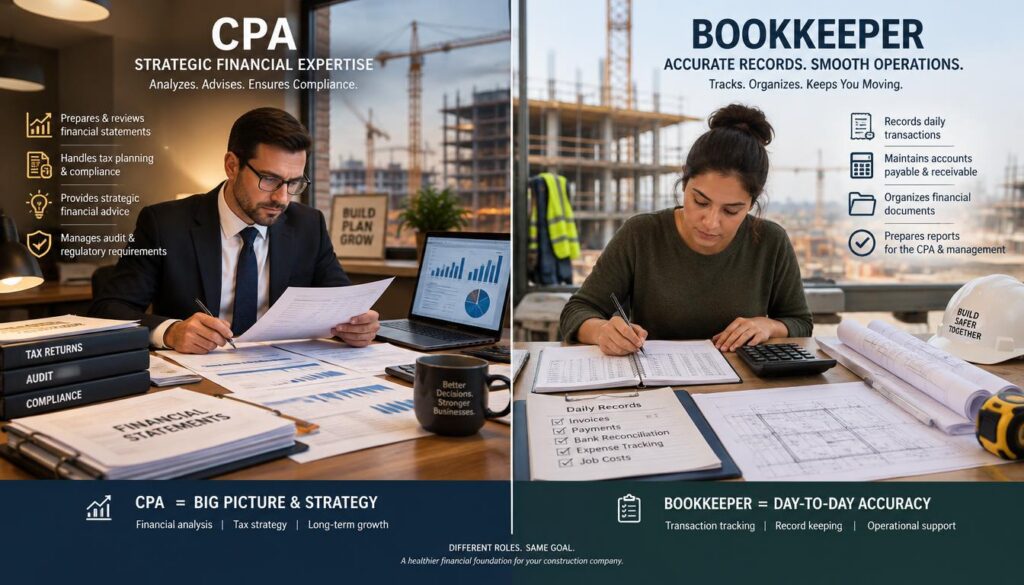
The difference between CPA and bookkeeper roles comes down to depth. One keeps your numbers accurate each day. The other interprets them to help guide your company’s future.
Both roles matter for a construction business. Firms like Jones CPA Group often provide both services. They help Houston contractors decide exactly what support they need.
| Aspect | Bookkeeper | CPA |
|---|---|---|
| Main Focus | Daily transaction recording | Tax strategy and financial analysis |
| Licensing | No license required | State-issued CPA license |
| Typical Tasks | Invoicing, bank reconciliation, payroll entries | Tax filing, audits, business advisory |
| Best For | Ongoing bookkeeping needs | Strategic planning and compliance |
2. What Does a Bookkeeper Do for a Construction Company?
Think of a bookkeeper as the person who keeps your construction company’s finances running smoothly each day. They handle the daily tasks that build a strong financial foundation for your business. Jones CPA Group offers bookkeeping services with CPA expertise, so Houston contractors get both under one roof.
When people compare bookkeeping versus CPA services, they may think bookkeepers only enter numbers into spreadsheets. In reality, a good construction bookkeeper does much more than basic data entry.
Daily Financial Tracking and Job Costing
A construction bookkeeper records each transaction as it happens. They track costs by project, rather than across the whole business, so you know where money goes.
This project-by-project breakdown is called job costing. It sorts expenses into clear categories, showing owners which jobs make money and which do not.

| Job Costing Category | What It Includes |
|---|---|
| Labor | Wages, overtime, payroll taxes, worker’s comp |
| Materials | Lumber, concrete, steel, fixtures |
| Equipment | Fuel, maintenance, rental, depreciation |
| Subcontractor Fees | Electrical, plumbing, HVAC |
A 2023 CFMA study found that 76% of construction firms using specialized job-costing tools saw improved profits. Only 34% of firms using general accounting software reported the same results. That gap shows why a bookkeeper who understands construction systems matters.
Managing Payroll and Vendor Payments
Bookkeepers handle weekly payroll for your crew, calculating wages and taxes correctly each time. They track vendor invoices and schedule payments, so suppliers ship materials without delays.
This steady payment cycle keeps subcontractors happy and job sites moving. Late payments can quickly stall a project, but a skilled bookkeeper helps prevent that problem.
Limitations of Bookkeeping Services
Bookkeepers provide accurate, current records, which are essential for running a construction business. However, bookkeepers typically are not licensed to build tax strategies, represent clients in IRS audits, or issue certified statements for bonding.
That is where the other side of bookkeeping versus CPA services matters. Once daily records are solid, a CPA turns them into a long-term financial strategy.
3. What Does a CPA Do for a Construction Company?
After daily bookkeeping ends, construction companies often need deeper financial expertise. That is where a CPA helps. A Certified Public Accountant uses numbers from the bookkeeper to offer strategy, support compliance, and prepare the business for growth.
This distinction explains cpa and bookkeeper roles in construction finance. Knowing each role helps owners build a financial team for every business phase.
Tax Planning and Compliance for Contractors
A skilled CPA helps contractors choose the right tax method for long-term projects. Many construction companies compare the percentage-of-completion method (PCM) with the completed contract method (CCM). Each method affects taxable income based on project timing and size.
A CPA also identifies deductions that bookkeepers rarely address, including Section 179 expensing and bonus depreciation on heavy equipment purchases. These strategies can significantly lower a contractor’s tax bill in a given year.
Payroll compliance adds complexity for contractors. Government-funded projects require Davis-Bacon Act wage rules and certified payroll records. A CPA ensures these filings meet strict federal standards.
Financial Strategy and Business Advisory
Beyond taxes, a CPA serves as a strategic growth partner. They forecast cash flow across multiple job sites, so payroll and material costs do not surprise owners.
CPAs guide choices such as leasing or purchasing equipment, weighing long-term costs against tax benefits. This data-based advice supports smarter bids and helps contractors plan expansion with confidence.
Audits, Reviews, and Financial Statements
Surety companies and lenders rarely provide bonding or credit without reviewed or audited financial statements. They closely examine working capital and debt-to-equity ratios before approving larger project bids.
A CPA prepares statements sureties trust, strengthening bonding capacity and opening doors to bigger, more profitable projects. Firms like Jones CPA Group deliver value that basic bookkeeping cannot match. They turn financial records into genuine growth tools for Houston construction businesses.
4. CPA vs. Bookkeeper: Key Differences in Roles and Responsibilities
Choosing between a bookkeeper versus certified public accountant starts with their training and rules. Both support your construction business in valuable ways. However, their titles, career paths, and legal services differ greatly.
Knowing these differences helps you match the right expert to each task at your Houston company.
Education, Licensing, and Certification Requirements
Becoming a CPA takes years of dedicated study. Candidates must complete specific college coursework in accounting and pass the demanding four-part CPA exam.
Texas also requires a set number of supervised work hours before granting a license. After certification, CPAs must complete continuing education every year to keep their licenses active and valid.
Bookkeepers follow a very different route. No state-mandated license or degree is required for this work.
Many bookkeepers teach themselves or train on the job through years of hands-on experience. Others pursue voluntary credentials, such as Certified Bookkeeper status, to strengthen their skills. This difference between cpa certification versus bookkeeper qualifications helps explain their different authority, responsibility, and cost.
Scope of Services Offered
These training differences shape what each professional can legally do for your construction company. Bookkeepers handle daily financial work, while CPAs manage higher-level strategy and compliance.
| Service Area | Bookkeeper | CPA |
|---|---|---|
| Daily Data Entry & Reconciliation | Yes, manages transactions daily | Rarely, reviews finished records instead |
| Job Costing & Invoicing | Yes, tracks project-level costs | Uses job cost data for tax strategy |
| Payroll Processing | Yes, manages weekly or biweekly runs | Advises on payroll tax compliance |
| Tax Filing & IRS Representation | No, outside legal scope | Yes, licensed to represent clients |
| Audits & Financial Statements | No, lacks certification authority | Yes, prepares audits and formal reviews |
These roles do not compete. They are built to work as a team.
Your bookkeeper keeps the books accurate and current every day. Your CPA uses that clean data to file taxes correctly, plan ahead, and guide major financial decisions. Knowing this division helps Houston contractors understand what they pay for with each hire.
5. Cost Differences Between Hiring a CPA and a Bookkeeper
One of the first questions Houston contractors ask is simple: how much will this cost me? The answer depends on your needs, but understanding the cost difference between CPA and bookkeeper services helps you plan confidently.
Bookkeepers usually charge less because their daily duties cover a narrower range of work. CPAs cost more upfront, but their training often saves money through better tax strategies and financial reports.
Typical Bookkeeper Rates for Construction Businesses
Most construction bookkeepers charge between $25 and $50 per hour. Many contractors choose flat monthly packages because they simplify budgeting.
Your final rate depends on several factors. Transaction volume matters, as does the number of active jobs you track. Payroll processing adds cost because it requires extra time and compliance attention.
A small residential contractor running two or three jobs pays far less than a commercial builder managing a dozen projects with full payroll.
Typical CPA Fees and What Influences Them
CPA fees are higher, often starting near $150 per hour for specialized construction accounting. These fees reflect years of education, licensing, and tax law expertise that bookkeeping services do not offer.
Several factors shape your final CPA bill. Company revenue matters, along with filings across multiple states or business entities. Contractors needing audited or reviewed financial statements for bonding should expect added fees because these reports require careful verification.
Higher upfront costs often pay for themselves. Strategic tax planning, stronger bonding capacity, and sound financial guidance can outweigh the initial investment and deliver real value. Jones CPA Group includes transparent pricing in every service package, so Houston contractors know what they pay and why.
| Service Type | Typical Rate Range | Primary Cost Drivers |
|---|---|---|
| Bookkeeper | $25–$50/hour or flat monthly fee | Transaction volume, active job count, payroll processing |
| CPA | $150+/hour or project-based fee | Revenue size, tax complexity, audited financials, advisory needs |
| Combined Package (Jones CPA Group) | Custom, transparent pricing | Business size, bonding requirements, growth goals |
6. When to Hire a Bookkeeper vs. When to Hire a CPA for Your Houston Construction Business
Choosing between bookkeeper and cpa becomes easier when you know which warning signs to watch. Many contractors wonder when to hire cpa or bookkeeper as their business grows. Clear red flags can guide your choice.
Some problems need daily financial cleanup. Others need strategic planning from a licensed CPA.
Signs You Need a Bookkeeper
If daily finances feel chaotic, a bookkeeper can quickly restore order. Watch for these common warning signs:
- Invoices are going out late or not at all
- Receipts and expense records are scattered or missing
- Vendor payments are falling through the cracks
- You can’t tell how much a specific job is actually costing you
- Bank accounts and job cost reports don’t match up
These signs show that your books need daily attention. A dedicated bookkeeper keeps records current, so you know where your money stands.
Signs You Need a CPA
Some challenges go beyond basic recordkeeping and need deeper financial expertise. A CPA becomes essential in these situations:
- Tax season is approaching and you have no strategy in place
- A bonding company is requesting reviewed or audited financial statements
- You’ve received a notice from the IRS and don’t know how to respond
- You’re planning to bid on larger public or commercial contracts
- You need WIP reports to catch over-billing or under-billing before it damages cash flow
That last point matters more than many contractors realize. Without accurate work-in-progress reports, you may overbill a client or underbill and lose job profit. A CPA with construction accounting experience can find these issues early and protect your bottom line.
Why Many Contractors Benefit from Both
Most growing construction companies eventually need both roles. A bookkeeper maintains daily records and keeps the business organized. A CPA uses that data for tax strategy, bonding support, and long-term growth planning.
Here is a quick comparison to clarify which role fits each need:
| Situation | Best Fit | Why It Matters |
|---|---|---|
| Late invoices, disorganized receipts | Bookkeeper | Restores order to daily financial tracking |
| Preparing for bonding or an audit | CPA | Provides reviewed financials lenders trust |
| Catching over/under-billing on jobs | CPA | Protects cash flow through WIP analysis |
| Ongoing payroll and vendor payments | Bookkeeper | Keeps operations running smoothly week to week |
Houston contractors can use Jones CPA Group instead of managing two separate vendors. The firm provides bookkeeping and CPA-level services under one roof. Your books and tax strategy stay aligned, with clear guidance from one trusted team.
7. Why Houston Construction Companies Trust Jones CPA Group
Choosing the right firm in an accounting professional comparison can feel hard until you find a team built for construction. Jones CPA Group is not a one-size-fits-all accounting firm. The firm understands Houston contractors’ daily needs, from job costing problems to compliance deadlines.
That focus makes a real difference. Contractors receive advice based on construction knowledge, not generic accounting templates.
Construction-Specific Accounting Expertise
Job costing, work-in-progress (WIP) reporting, and progress billing are not side skills for Jones CPA Group. They are core services for general contractors and trade contractors every day.
This experience means fewer surprises when tax season arrives. It also means bids use accurate numbers instead of guesswork.
Certified payroll compliance is another area where specialization pays off. Contractors bidding on public works projects need accurate reports to meet wage rules. Jones CPA Group helps clients meet those standards without added stress.
Strong financial reporting also supports a major contractor concern: bonding capacity. Clean books and reliable WIP schedules help contractors qualify for larger projects and bigger bonds.
Local Knowledge of Houston, Texas Regulations
Being based in Houston is more than a location on a business card. It shapes how Jones CPA Group serves construction clients across the region.
The team knows Texas franchise tax requirements inside and out. This knowledge helps contractors avoid costly filing mistakes that generalist firms sometimes miss.
Local permitting and licensing rules vary by municipality, and Houston’s construction market has its own quirks. Jones CPA Group tracks these details, so clients do not have to guess.
Prevailing wage compliance matters, especially for contractors pursuing public works contracts in the Houston area. Knowledge of Texas wage rules helps clients avoid penalties and keep projects moving.
This local insight includes subcontractor networks and municipal rules that shape construction financing and project completion in Texas. Out-of-state and generalist firms cannot easily match this regional knowledge. It helps Houston contractors see Jones CPA Group as a partner, not just another vendor.
8. Conclusion
Every Houston construction company depends on accurate numbers. Bookkeepers organize daily records, tracking job costs, payroll, and vendor payments so nothing gets missed. CPAs provide the bigger picture through tax planning, financial strategy, and compliance, helping businesses grow and compete for larger contracts.
The cpa vs. bookkeeper question does not always have one answer. A new contractor may need only daily bookkeeping. A growing firm bidding on bigger projects often needs both: a bookkeeper for accuracy and a CPA for strategy.
Your business stage and goals should guide this decision. Jones CPA Group works with Houston contractors every day, helping them choose support that fits their current needs. Whether you need dependable bookkeeping, high-level CPA guidance, or both, our team understands construction inside and out.
Reach out to Jones CPA Group today for a consultation. Let’s discuss where your business stands and what it needs to build a stronger financial foundation for the future.
FAQ
What’s the main difference between a CPA and a bookkeeper?
The difference between a CPA and bookkeeper involves scope and licensing. A bookkeeper records daily transactions, including invoicing, reconciliations, and job costing. A CPA is licensed and provides tax strategy, financial statement reviews, and business advice for major decisions.
How do CPA and bookkeeper roles work together in a construction business?
CPA and bookkeeper roles work together rather than compete. Your bookkeeper tracks job costs, payroll, and vendor payments in accurate, current records. Your CPA uses this data for taxes, bonding, financials, and cash-flow forecasts; Jones CPA Group serves Houston contractors this way.
Is bookkeeping versus CPA services really an either-or decision?
Not necessarily. Some smaller construction businesses start with bookkeeping versus CPA services and add the other as they grow. Most established contractors eventually need both: bookkeepers build the foundation, while CPAs add strategic tax planning, audits, and bonding support.
What’s involved in choosing between a bookkeeper and a CPA for my Houston contracting business?
Choosing between a bookkeeper and a CPA depends on your current needs. If daily records, invoicing, or job-cost tracking cause trouble, start with a bookkeeper. For tax season, surety financials, or larger commercial projects, add a CPA or hire a firm offering both.
How does cpa certification versus bookkeeper qualifications affect the level of service I receive?
CPA certification versus bookkeeper qualifications shows differences in training and legal authority. CPAs complete college coursework, pass the four-part CPA exam, meet state experience requirements, and continue education; bookkeepers need no license. Skilled bookkeepers may pursue Certified Bookkeeper credentials; CPAs can represent businesses in IRS audits or issue certified financial statements.
Can you give a quick accounting professional comparison for construction companies specifically?
In a straightforward accounting professional comparison, bookkeepers manage data entry, reconciliations, job costing, invoicing, and payroll processing. CPAs handle tax filings, IRS representation, audited or reviewed financial statements, and strategic consulting for bidding, growth, and bonding capacity. Construction companies need both daily accuracy and higher-level strategy to run smoothly and grow confidently.
Is a bookkeeper versus certified public accountant decision based mostly on company size?
Company size matters, but it is not the only factor. A bookkeeper versus certified public accountant decision also depends on complexity, active jobs, bonding needs, and tax issues. A small residential contractor may need bookkeeping; a growing commercial contractor pursuing public works needs CPA-level planning and certified financials.
Why should Houston, Texas contractors work with a locally based accounting firm?
Houston, Texas has a unique regulatory landscape, including Texas franchise tax rules, local permitting, and prevailing-wage compliance for public works. A Houston firm understands regional requirements, subcontractor networks, and municipal processes better than out-of-state or generalist firms. It becomes a strategic partner, not merely a service provider.
What questions should I ask myself when deciding when to hire CPA or bookkeeper support?
To decide when to hire CPA or bookkeeper support, ask whether invoicing or job costing is behind. Also ask whether you need reviewed financials for a bonding company or received an IRS notice.Are you planning to bid on larger public or commercial projects? Start with a bookkeeper for daily disorganization; choose a CPA for strategy, compliance, or growth.